Automatic Tan Delta and Capacitance Bridge
This set includes the Bridge Model MTAND and the HV Supply Model HLS12A, along with all the necessary cables, creating a laptop-based system that runs on Visual C++ Windows software. It’s designed to be incredibly versatile and user-friendly, making it perfect for precise measurements. With a laptop and a Windows interface, you can easily store, access, and analyze data right on-site.
The system automatically adjusts the Tan Delta values of the tested object for temperature variations, following IEC standards. You can view the results on a vibrant color display, complete with graphical plots for:
– Tan Delta vs. Voltage
– Tan Delta vs. Time
- There manually selectable convince DC ranges for application
- Cable and cable sheath testing up to 12 kV between metallic sheath / armoured and mass of earth.
- Automatic sheath fault pre-location with high precision measuring bridge method.
- Cable sheath fault pin pointing by pool of potential method.
- Automatic discharging facility of cable under test, in case of power failure or after switching off.
- Conversion of high-resistance faults in low-voltage cables.
- Burn mode for conditioning the sheath fault.
- It is extremely user friendly in obtaining the fault distance; it uses a micro-controller based fault distance calculator that enables the operator to get the pre-location measurements with precise accuracy.
- Continues operation for extended period in case of pin-point difficult sheath faults.
- Rugged construction and easy to carry on site.
| Model Name | MTAND | |
|---|---|---|
| Test Sepcifications | ||
| Test Voltage | 0 to 12 kV | |
| Rated Current | 100mA Continuous, 200mA for 2minutes & 1000mA @ 2.5kV | |
| Automatic balancing through windows based software. | ||
| Automatic & software controlled voltage setting to avoid abrupt voltage rise. | ||
| Automatic selection of seven different modes of operation for measurement of 3 terminal object from windows based software . | ||
| Standard Capacitor | 100pF, 12KV built-in. | |
| Input Frequency | From 50 Hz ( lines frequency) , + 5% | |
| Power Required | 230 V Ac + 10%, 1 phase Ac , 50Hz. | |
| Capacitance | ||
| RANGE | 10pF to 1.1µF, | |
| RESOLUTION | 0.01pF | |
| ACCURACY | +0.5% of the reading +1 pF in UST Mode | |
| Tan Delta | ||
| RANGE | 100V –12 KV & Tapping at 2.5kV | |
| RESOLUTION | 1.0 V | |
| Accuracy | +1% of reading +1 digit | |
| Current Measurement | ||
| RANGE | 0 – 100 mA Continuous 200mA Short term @ 12kV and 1000mA @ 2.5kV Tap Optional | |
| RESOLUTION | 1 mA | |
| ACCURACY | +1 %, +1digit | |
| Power Factor | ||
| RANGE | 0 – 1 | |
| RESOLUTION | 0.01%(0.0001) | |
| ACCURACY | +0.5% of the reading +0.0002 | |
| Power Supply | ||
| Power Input | 230 Volts +10%,50Hz, Single phase. | |
| Power Output | 0-12KV , 100mA Continuous, 200mA Short term & 0-2.5kV Tap Optional, 1000mA | |
| Test Frequency | ||
| Line Frequency, Optional Generated Frequency from 45Hz to 70Hz available for testing at 12kV | ||
Related Products
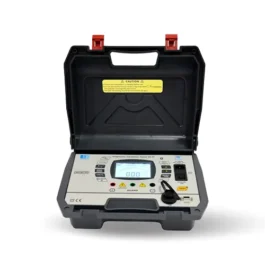
The 5K PI Insulation Diagnostic Tester is a state-of-the-art tool crafted to provide dependable diagnostic testing for high-voltage equipment like Transformers, Cables, Bushings, Insulators, Switchgears, Lightning Arresters/Surge Arrestors, and Rotating Machines.
Built with precision and durability in mind, the 5K PI features a lightweight, compact design paired with cutting-edge technology to guarantee reliable performance, even in tough conditions. Developed in our advanced R&D lab and certified to meet the necessary IS/IEC standards, it’s the perfect choice for both fieldwork and outdoor use.
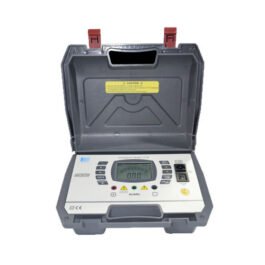
The Motwane IT-51 microprocessor-based digital insulation tester is a cutting-edge tool that makes diagnosing high-voltage equipment a breeze. This microprocessor-controlled device is perfect for testing a variety of electrical gear, from transformers and switchgear to motors, generators, cables, and substation components.
With its dual-display system featuring both digital and analog readouts, you can enjoy improved monitoring and accurate measurements. Plus, the IT-51 takes care of Insulation Resistance (IR) and Polarization Index (PI) tests automatically, ensuring you get reliable and consistent results every time.
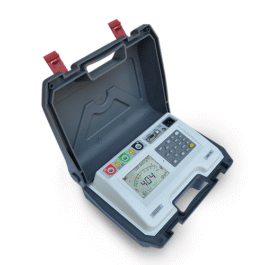
10K PI is an Insulation Diagnostic Tester having test voltage range up to 10KV, designed & developed indigenously at the state of the art R&D laboratory to conduct automatic insulation tests on high voltage equipment’s like Transformers, Cables, Bushings, Switchgears & Rotating Machines.
10K PI comes in two ranges of short circuit current of 3mA and 6mA. 10K PI is a microprocessor based instrument deploying the latest technology & very high speed data sampling to give correct, repetitive readings & quality performance under harsh electrical conditions. It has a wide insulation resistance range up to 50TΩ.
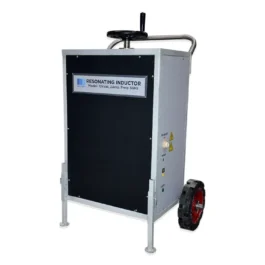
The Resonating Inductor is a high-efficiency accessory that boosts the performance of the MTAND 12-kV Automated Insulation Test Set by expanding its capacity for capacitance and dissipation factor measurements. It works by offsetting reactive power, enabling accurate and consistent testing of large capacitive components such as power cables, high-capacity motors, and generators.