Transformer Turns Ratio Meter
The Motwane XTRM-3 is a cutting-edge, fully automated testing system that provides accurate and efficient analysis of transformer parameters. Thanks to its advanced technology and smart features, it has become an essential tool for professionals involved in power transformer testing and diagnostics.
- Test Voltage : 10V, 40V, 100V
- Measure Turns Ratio, Voltage Ratio & Ratio Error
- Measure Phase Deviation & Excitation Current
- Auto Detection of Transformer Vector Group
- Quick set up with intuitive guide
- Inbuilt Printer with Memory for 500 test results
- Bluetooth enabled for MOT-WARE Mobile App
| Technical Specifications | |
| Power supply | 115V/230V AC, 50/60 Hz |
| Measurement ratio | 0.8 : 10000 |
| Test voltage | 10V AC, 40V AC, 100V AC |
| Ratio Accuracy | 10 V: ▸ ±0.15% (0.8 – 1000) 40V & 100V: ▸ ±0.1% (0.8 – 1000) ▸ ±0.15% (1001 – 2000) ▸ ±0.20% (2001 – 4000) ▸ ±0.25% (4001 – 10000) |
| Excitation Current | Upto 2A; Resolution: 0.1mA |
| Phase Angle | • Range: ±180° • Resolution: 0.01 • Accuracy: ±0.50° ± 1 digit |
| Communication/Control Software | LCD display, USB Interface for PC Control |
| Report Storage | 500 reports (250 each for Single Phase & Three Phase) |
| Environmental Specifications | • Operating Temperature : 0 °C to 40 °C • Storage Temperature : -10 °C to 60 °C • Relative Humidity : ≤ 95%RH at 400C max. (non-condensing) |
| Physical Specifications | |
| Dimensions: | ▸188 mm (H) X 401 mm (W) X 502 mm (L) |
| Weight: | ▸ 10Kg Approx. (Excluding accessories) ▸ 21Kg Approx. (Including accessories) |
| Safety features | |
| Safety/EMC in accordance with EN 61010-1, EN 61326-1 | |
| CE certified | |
| Ingress protection IP 67 / CAT III 600V | |
| Emergency stop | |
| Full Windows compatible software | |
| Software is fully compatible with Microsoft | |
| Type : Window based Software | |
| Interface : USB communication port | |
| Features: | |
| ▸ Remote Operation | |
| ▸ Data downloading | |
| ▸ Analysis and report generation | |
| Accessories | |
| Standard Accessories | |
| ▸ Mains Power Cord – 3 Mtr | |
| ▸ Main Protected Fuse | |
| ▸ 15 meters test lead set with alligator clips | |
| ▸ Thermal paper roll | |
| ▸ Instruction manual | |
| ▸ Calibration certificate | |
| ▸ OLTC Probe (10 Meter) | |
| ▸ Pen Drive | |
| ▸ USB cable | |
| ▸ Carrying bag Test Lead | |
| Optional Accessories | |
| ▸ Bluetooth | |
| ▸ Motware Desktop App | |
| ▸ Test Lead For XTRM-3, 20 Mtr | |
Related Products
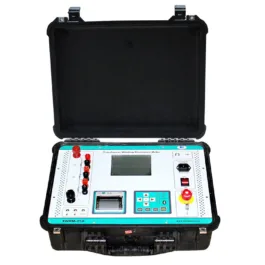
The Motwane XWRM is a top-notch testing tool designed for quick, dependable, and accurate measurement of winding resistance in highly inductive devices like transformers, reactors, generators, and high-tension motors.