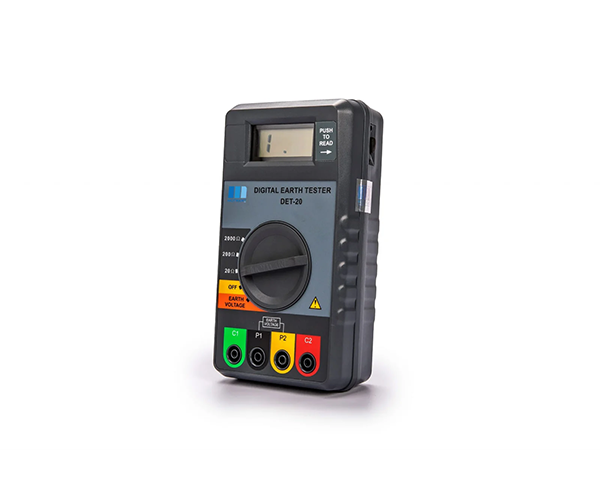


Earth Testers
The DET 20 is a reliable 3½ digit LCD meter designed for accurate measurements of earth resistance, soil resistivity, and earth voltage. Thanks to its cutting-edge RSR technology, it delivers stable and precise readings, even when the battery starts to run low. Built tough for heavy-duty tasks and challenging environments, this instrument is your go-to for dependable performance.
- 3½ digit LCD Display with max reading 1999.
- 3 terminal and 4 terminal Measurement Method
- Earth Resistance Range 0.01Ω to 1999Ω
- 4 Soil Resistivity Measurement
- Rechargeable Internal Ni-MH Battery
- Earth Measurement Voltage up to 200V
- Ratio Metric Synchronous Rectification
| Technical Specifications | |
| Power | |
| Mains Power Supply: | Internal, replaceable alkaline battery 1.5V x 6nos |
| Auto Power OFF: | After 10 min |
| Earth Resistance Range & Accuracy | |
| Range: | 0.0001Ω to 20.000 kΩ Auto Range |
| Accuracy: | at 25C + 2C 0.5% of reading + 2 digits 3P ± 10mΩ |
| Test Parameters | |
| Test Frequency: | 128Hz (± 0.5Hz) |
| Test Current Injection: | 10mA AC approx. @ 19.999Ω range 1mA AC approx. @ 199.99Ω range 100µA AC approx. @ 1999.9Ω range |
| Open Circuit Voltage: | < 40Volt AC approx |
| Earth Voltage Measurement | |
| Range: | 2V to 200V AC (±2% of the range ±2v.) |
| Resolution: | 0.1V |
| Display: | 4 ½ digit LCD Display with pleasant backlit |
| PC Interface: | USB |
| Report Storage: | 1000 Reports |
| Data Transfer: | Bluetooth (ISM Band 2.4GHz) (optional) |
| Soil Resistivity: | Method Wenner: PE = 2 π a Rw (Ωm) |
| General | |
| Dimensions: | 230 mm(H) X 165 mm(W) X 95 mm(L). |
| Weight: | 1.35 Kg (Approx.) |
| Environmental | |
| Operating Temperature: | 0 C to 55C |
| Storage Temperature: | 0-10C to 60C |
| Relative Humidity: | 95% RH at 40C max. (Non Condensing) |
Related Products
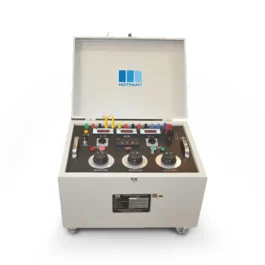
The Motwane RTS Series, often referred to as the Secondary Current Injection Kit, is a handy and budget-friendly tool designed for testing protective relays that operate on both voltage and current. Crafted with precision and user-friendliness in mind, it ensures reliable performance for testing relays and protection systems.
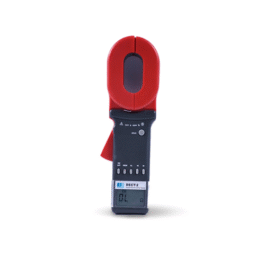
Motwane’s Digital Clamp-On Earth Resistance Testers – the DECT-2 and DECT-3 – are cutting-edge tools crafted to measure earth resistance quickly, safely, and accurately, all thanks to their modern clamp-on technology.
This innovative approach means you don’t have to disconnect the ground rod, making it perfect for locations where multiple grounds are set up in parallel. Just clamp it around the conductor or earthing strip, and you’ll get precise resistance readings, allowing for efficient testing without any disruption to the grounding system.
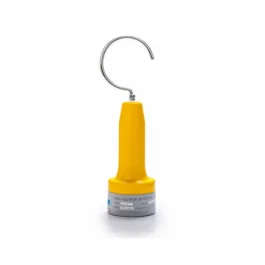
Motwane’s HV Detector Series is all about keeping users safe while making things easy to use in a compact and reliable electrical safety device. Perfectly suited for medium to extra-high voltage settings, these detectors come equipped with smart LED layouts, built-in audible alarms, and cutting-edge self-test features to ensure they deliver precise and trustworthy performance.
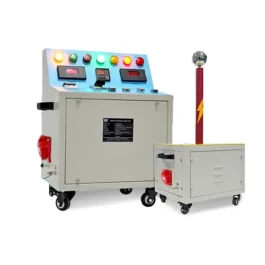
The Motwane HVT Series is crafted to assess how well electrical insulation can handle overvoltage transients. With a broad spectrum of test voltages, this series simplifies your testing needs by combining AC, DC, and AC+DC testing into one convenient system. Designed for reliability, durability, and user-friendliness, the HVT Series is the perfect solution for essential high-voltage testing tasks.
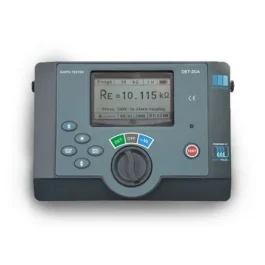
The DET-20A Digital Earth Tester is a tough, high-precision tool crafted to measure Earth Resistance, Soil Resistivity, and Earth Voltage with both reliability and accuracy. It boasts a 4½-digit LCD display with a backlight, and it uses RSR (Ratio Metric Synchronous Rectification) technology to ensure stable readings, even when the battery voltage dips.
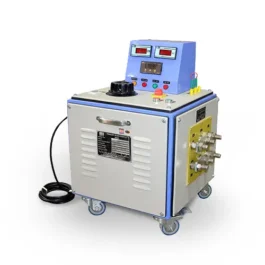
The MOT-PIK Series from Motwane is a reliable and high-performance choice for testing and commissioning protection systems in electrical substations. Designed with efficiency and user-friendliness in mind, this series boasts a robust output current of up to 3000 Amps and a burden capacity of 20kVA, making it perfect for heavy-duty and high-impedance testing tasks.