How Moisture Affects Insulation Resistance and How to Prevent It
Published On: Aug 27, 2026
6 min read
Insulation plays a crucial role in ensuring the proper and expeditious function of electrical appliances, providing protection against undesired current flow. However, the infiltration of moisture into insulation materials results in lower insulation resistance and increases the leakage current, thereby causing the insulation to start deteriorating. The nature of this deterioration is typically silent; thus, the damage is due to be discovered at the time of testing or during failures only.
Share:
Why Moisture Is a Serious Threat to Insulation
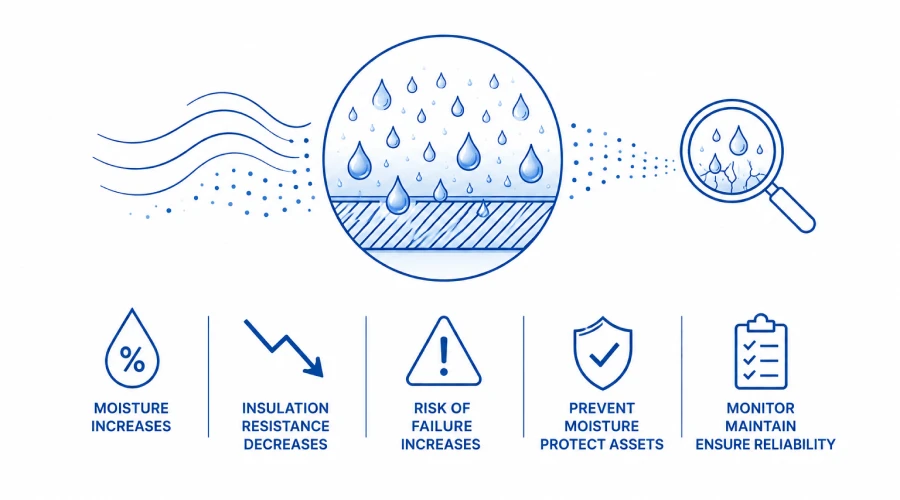
Moisture is a common contaminant in electrical insulation by decreasing insulation resistance (IR). When insulation becomes wet, it provides paths for undesired electrical currents, resulting in the reduction of the IR. Moreover, moisture increases electrical breakdown strength; the resistance to electrical stress of insulation just before it fails. Even small traces of moisture in a transformer change its electrical insulation strength.
What Actually Changes Inside the Insulation
When water penetrates insulating materials, three unrelated problems arise, and successful diagnosis depends on distinguishing them from one another:
- Conduction: Water acts as a solvent, and thus ionic impurities or soluble salts get dissolved from the insulation.
- Polarization: Water has a much higher dielectric constant than polluted materials; values are 80, 4.4, and 2.2, respectively, for water, cellulose, and mineral oil. Even a tiny amount of water will cause incremental increase of capacitance and slows dielectric response.
- Surface conduction: Water on the surface of insulators permits the current to flow on the surface while keeping insulation dry underneath.
Because these effects behave differently during tests with voltage applied, it is impossible to use a single IR reading to determine the type of effect present. The use of a structured sequence including Polarization Index (PI), Dielectric Absorption Ratio (DAR), Dielectric Discharge (DD), and Step Voltage (SV) helps differentiate between the effects.
How Moisture Enters Electrical Equipment
Moisture infiltrates equipment through multiple routes, most building up slowly enough to evade detection:
- High-humidity air
- Rainwater
- Condensation from temperature differences
- Damaged seals and gaskets
- Loose fittings
- Openings
- Panels were left unsealed after maintenance.
Condensation is a major cause of moisture settling in an enclosure. Motors, transformers, switches, and cables stored in wet surroundings may absorb water before commissioning, so if insulation is not checked before power-up, equipment begins operating with poor insulation quality.
The Cost of Ignoring Moisture
Moisture damage compromises the effectiveness of the insulation system. When cellulose insulation, such as transformer paper, undergoes multiple wet-dry cycles, it loses flexibility and becomes more prone to damage. According to the International Association of Engineering Insurers (IMIA), insulation malfunction is one of the principal causes of transformer failure, accounting for almost 25% of reported failures but nearly half of related financial losses.
Detecting Moisture Before It Leads to Failure
Moisture-related deterioration is hard to detect visually due to its gradual progression. Regular IR testing must be part of preventive maintenance, since a low IR reading alone may point to several factors: moisture ingress, contamination, or aging. Testers such as Motwane's 5KPI and 10KPI support this, providing accurate IR readings along with other testing capabilities so personnel can track conditions over time.
Motwane 5KPI and 10KPI: What Sets Them Apart
The features below are stated in terms of the benefit they deliver in moisture diagnosis and condition-based maintenance, rather than as a specification list. Details regarding specifications given in the following section.
| Capability | What It Does | Why it matters for moisture |
|---|---|---|
| Complete diagnostic suite | IR, PI, DAR, DD, SV, BDV in one instrument; Burn mode on 10KPI | Full diagnostic signature from a single instrument |
| Guard terminal (300 kΩ) | Diverts surface leakage from the measuring circuit | Separates surface condensation from bulk insulation, the most common false alarm during monsoon |
| Selectable short-circuit current | 3–6 mA on the 5KPI/10KPI | Stabilizes large capacitive assets fast enough for a practical 10-minute PI test. |
| Three-level digital filter (F-1 / F-2 / F-3) | F-1/F-2/F-3 noise suppression | Repeatable readings in live, noisy switchyards |
| High interference rejection | Up to 8 mA rejection capacity | Enables testing in heavily induced EHV environments without a wider outage |
| Finely adjustable lock voltage | 10–50 V steps | Enables a true multi-point step-voltage profile, exposing ionic conduction even when single-voltage IR looks acceptable |
| Capacitance measurement | 1 nF–50 µF, logged with each test | Temperature-insensitive cross-check on resistance trends |
| 1000-reading memory | Isolated RS232/USB, with PC software | Builds a defensible condition history, the only way a slow moisture trend is detected |
| Automatic discharge & warnings | Controlled discharge after test, audio-visual alerts | Safety on capacitive assets, faster field test cycles |
| Safety certification | CAT IV 600 V, IEC 61010-1, IEC 61557-1/-5, CE | Permit for use in switchyard and incoming-supply locations |
| Field-ready construction/td> | Battery/mains operation, sealed enclosure, auto power-off | Enables on-site testing in the conditions that caused the problem |
| Indigenous design | Developed and built in India, local support | Faster calibration/repair turnaround, an edge in utility tenders |
Table 1: Capability-to-benefit mapping for 5KPI and 10KPI.
How to Prevent Moisture Damage
A proactive maintenance program should minimize moisture exposure while preserving insulation integrity throughout the equipment's service life:
- Control climatic conditions: Regulate humidity in electrical rooms with dehumidifiers, ventilation, air-conditioning, or heaters to combat condensation and maintain consistent conditions.
- Protect the enclosure: Regularly inspect seals, gaskets, cable glands, covers, and joints; replace defective components promptly to keep out water and humid air.
- Clean the insulation area: Dust and other contaminants raise humidity and affect insulation surfaces, so clean bushings, insulators, and terminals regularly to limit leakage current.
- Check storage facilities: Inspect equipment stored in humid environments before commissioning, especially motors, transformers, and cables idle for prolonged periods.
- Implement condition-based maintenance: Base maintenance on effective insulation assessment methods and continuous condition monitoring.
Conclusion
Moisture is a major cause of insulation damage, reducing insulation resistance, decreasing dielectric strength, and hastening aging. Because these changes happen gradually, relying on visual inspection or sporadic measurements means faults may go undetected until they cause equipment failure.
An effective moisture control scheme combines environmental regulation, enclosure upkeep, correct storage, and periodic IR measurement, helping maintenance teams catch early signs of deterioration. Motwane's 5KPI and 10KPI Insulation Resistance Testers support exactly this kind of condition-based approach.
 Aug 27, 2026