Common Causes of Insulation Failure in Electrical Equipment
Published On: Aug 27, 2026
6 min read
The insulation has the deciding influence on safety and reliability of equipment such as transformers, motors, generators, switchgears, and cables. It conveys electricity, prevents leakage and failures. However, thermal, mechanical, electrical and environmental stress ruin insulation in the course of operation therefore, it is important to understand failure processes.
Share:
Why Insulation Failure Deserves Attention
The main cause of insulation damage is internal factors rather than mechanical issues, thus making it hard to detect insulation failure until it is completely not functional. Thus, the equipment may seem to work normally until it fails.
Mechanisms Do Not Act Alone
Insulation failure always involves several factors. Heat makes insulation brittle, while vibration can cause cracks that create pathways for moisture entry. Moisture can lead to the formation of air pockets where an insulation material is subject to high electrical stress and partial discharge occurs. These interactions matter in diagnostics because different tests address different phases of degradation. Insulation resistance testing is useful in assessing moisture and contamination effects but does not directly detect partial discharge.
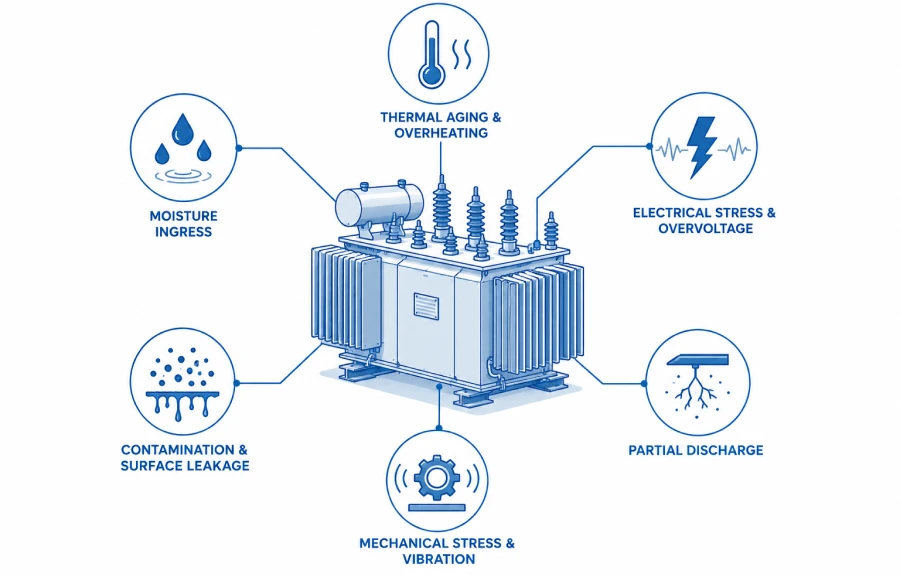
Common Causes of Insulation Failure
Thermal Aging and Overheating
Heat is a major contributor to insulation breakdown. When insulation exceeds its designed temperature due to overloading, poor cooling, or inadequate ventilation, it degrades rapidly, losing flexibility and electrical strength.
According to Arrhenius ageing theory, a 10°C rise in operating temperature can approximately halve insulation life in many systems. In transformers, hot-spot temperature is more critical than average winding or top-oil temperature because it determines the ageing rate. IEC 60085 defines thermal insulation classes.
| Thermal class | Rated temperature | Typical materials and applications |
|---|---|---|
| A | 105°C | Cellulose and cotton impregnated in oil or varnish; older machines and oil-filled apparatus |
| E | 120°C | Enameled wire systems in small machines |
| B | 130°C | Mica, glass fiber and asbestos-free composites with organic binders |
| F | 155°C | Mica and glass with higher-stability resins; the common class for modern industrial motors |
| H | 180°C | Silicone-bonded mica and glass; high-temperature and high-duty machines |
| N / R and above | 200°C and higher | Specialist high-temperature systems |
Table 1: Thermal Insulation Classes and Their Corresponding Temperature Ratings as Defined in IEC 60085.
Moisture Ingress
Moisture reduces insulation resistance and dielectric strength, entering through damaged seals, condensation, flooding, or other openings.
- In transformers, moisture accelerates cellulose degradation
- In motors and cables, it increases leakage current and surface tracking
- Water also drives cellulose hydrolysis, worsening degradation over time
Condensation depends on the relationship between surface temperature and dew point, which is why anti-condensation heaters are commonly used on idle equipment.
Contamination and Surface Leakage
Outdoor and industrial equipment accumulates dust, oil, salt, and chemical deposits, which combine with moisture to form conductive surface paths. The leakage current causes localized heating that accelerates insulation breakdown, putting coastal areas, cement plants, fertilizer plants, and oil refineries at particular risk.
Cleaning frequency should be based on pollution severity rather than a fixed annual schedule. Surface leakage itself can be evaluated using an insulation tester's guard terminal, comparing readings with the leakage path included and excluded.
Electrical Stress and Overvoltage
Lightning surges, switching transients, and repeated voltage spikes progressively damage insulation. These defects can develop into electrical treeing; branching conductive paths that lead to dielectric breakdown. High-voltage equipment with frequent switching is especially vulnerable, making surge protection critical.
Electrical Treeing vs. Water Treeing:
- Electrical Treeing: Develops under high electric-field stress, can progress rapidly, and may involve partial discharge.
- Water Treeing: Moisture-related degradation mainly affects polymeric cable insulation (e.g., XLPE); develops slowly and may not produce partial discharge.
Because water-treed cables can still show satisfactory readings, IR testing should be treated as a preliminary screen for medium-voltage polymeric cables in wet or buried environments. Where water treeing is suspected, tan delta or other low-frequency diagnostic test can provide deeper assessment.
Partial Discharge (PD)
PD occurs when localized electrical discharges develop within voids, cracks, or other insulation defects, without completely bridging the conductors. It's a subtle but progressive failure mode, each discharge event is small on its own, but repeated activity steadily erodes the surrounding insulation over time.
If unaddressed, this repeated activity can eventually lead to dielectric breakdown. PD measurements are valuable precisely because they help identify defects tied to local electrical stress; including voids and other irregularities, well before they escalate into a full failure.
Mechanical Stress and Vibration
Continuous vibration, thermal expansion/contraction, electromagnetic forces, and mechanical damage cause cracking, abrasion, or displacement. Installation and handling add further stress through excessive cable bending, inadequate securing, or transport damage. Once defects form, moisture and contaminants penetrate and accelerate deterioration.
Detecting Insulation Problems Before Failure
Visual inspection alone can't catch many internal defects; electrical diagnostic tests are essential. Motwane's 5KPI and 10KPI Insulation Resistance Testers support multiple diagnostic modes for assessing transformers, motors, generators, switchgear, and power cables.
The Five Tests at a Glance
| Test | Applied signal | Result parameter | Diagnostic significance |
|---|---|---|---|
| IR | Single voltage, held | Resistance at 60s | Overall condition; gross moisture/ contamination |
| DAR | Single voltage, held 60s | R at 60s ÷ R at 30s | Rapid screen when outage time is short |
| PI | Single voltage, held 10 min | R at 10 min ÷ R at 1 min | Moisture and contamination distinguished from ageing |
| DD | Charge to full, then remove supply | Discharge current at 1 min ÷ (V × C) | Defect confined to one layer of a multi-layer insulation system |
| SV | Voltage raised in equal steps and duration | IR at each step | Ionic conduction, moisture, and voltage-dependent weak spots |
Table 2: Diagnostic modes of the Motwane’s 5KPI and 10KPI.
Safety Precautions During Testing
Before insulation resistance testing:
- Isolate, lock out and tag out the circuit; verify it's de-energized.
- Discharge and ground capacitive equipment before and after testing
- Disconnect surge protectors, capacitor banks, VTs, CTs, and electronic devices that may not withstand DC voltage
- Barricade and control the remote end of cables and long runs
- Keep the tester connected during discharge; confirm voltage has returned to zero before handling leads
- Do not test during rain or on wet surfaces
- Select the appropriate test voltage and verify connections before testing
Building a Reliable Preventive Maintenance Strategy
Preventing insulation failure means addressing the factors that accelerate ageing, overheating, moisture ingress, surface contamination, electrical transients, and mechanical stress before they compound into failure. Regular diagnostic testing gives maintenance teams the condition data needed to prioritize equipment based on actual insulation health, rather than relying on fixed inspection schedules that may miss developing problems.
Conclusion
Insulation breakdown results from thermal, electrical, mechanical and environmental stresses working in synergy to accelerate the process of deterioration and increase the risk of failure. In order to identify problems before they arise, it is important to understand this process and use proper diagnostic tests. The Motwane 5KPI and 10KPI insulation testers provide exactly this with their features for comprehensive analysis.
 Aug 27, 2026