Guard Terminal in Insulation Testers: Why It Is Crucial for Accurate Measurements
Published On: Aug 27, 2026
5 min read
Insulation resistance (IR) testing is key to assessing transformers, motors, generators, switchgear, bushings, and power cables, but precise results are hard to get in real-world conditions. Even healthy insulation can show low resistance due to contaminants and moisture creating extra leakage paths. The Guard terminal solves this by isolating surface leakage current from true insulation current.
Share:
Why Insulation Resistance Measurements Can Be Misleading
Insulation resistance testing applies DC voltage and measures leakage current, from which resistance is calculated by Ohm's Law:
Insulation Resistance (R) = Applied Voltage (V) / Leakage Current (I)
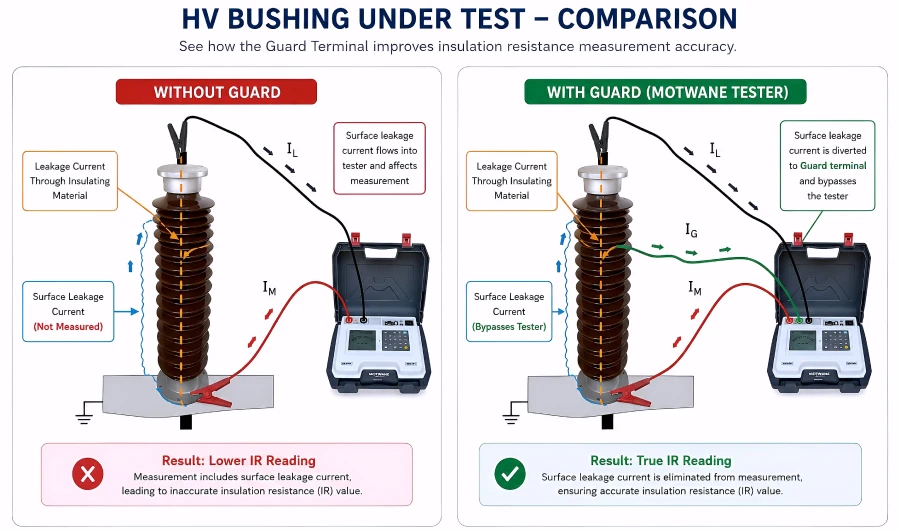
For reliable reading, measured current must reflect only current through the insulation. But equipment exposed to moisture, dust, oil, salinity, and chemicals develops a conductive surface path that adds leakage current to the readings. Traditional testers measure total leakage current without distinguishing bulk from surface current, so leakage gets misread as degradation, most pronounced in high-resistance systems (GΩ/TΩ), where a small leakage current can change the result.
The Two Paths Are in Parallel - Which Is Why the Error Is So Large
Bulk insulation and a contaminated surface aren't separate phenomena; they're two resistances between the same terminals (conductor and ground), acting in parallel, where the lower resistance dominates:
- 10x higher surface resistance than bulk insulation lowers the reading by ~9%.
- Equal surface and bulk resistance lower it by ~50%.
- 10x lower surface resistance (wet/salt) lowers it by ~90%.
The instrument reports the combined value faithfully, with no way to separate the two.
Arithmetic for an asset with true insulation resistance fixed at 10 GΩ
| Surface condition | Surface path | Displayed reading | Error |
|---|---|---|---|
| Clean and dry | 1000 GΩ | 9.9 GΩ | 1 % |
| Light dust film | 50 GΩ | 8.3 GΩ | 17 % |
| Damp after a cool night | 5 GΩ | 3.3 GΩ | 67 % |
| Salt film after coastal rain | 1 GΩ | 0.91 GΩ | 91 % |
| Carbon tracking on a bushing | 0.1 GΩ | 0.099 GΩ | 99 % |
Table 1: Insulation is unchanged at 10 GΩ; only the surface condition varies.
This carries real risk, in Row 4, a healthy asset reads 0.91 GΩ and gets taken out of service over a wet morning. Row 5 is worse differently, the reading looks unambiguously bad, but the real defect (surface tracking) gets misattributed to bulk insulation.
How the Guard Terminal Improves Accuracy
The Line (L) and Earth (E) terminals form the basic test circuit; the Guard (G) terminal gives surface leakage current an alternative path, diverting it from the measurement circuit. This matters most on high-voltage equipment, where small errors can cause wrong conclusions about insulation health.
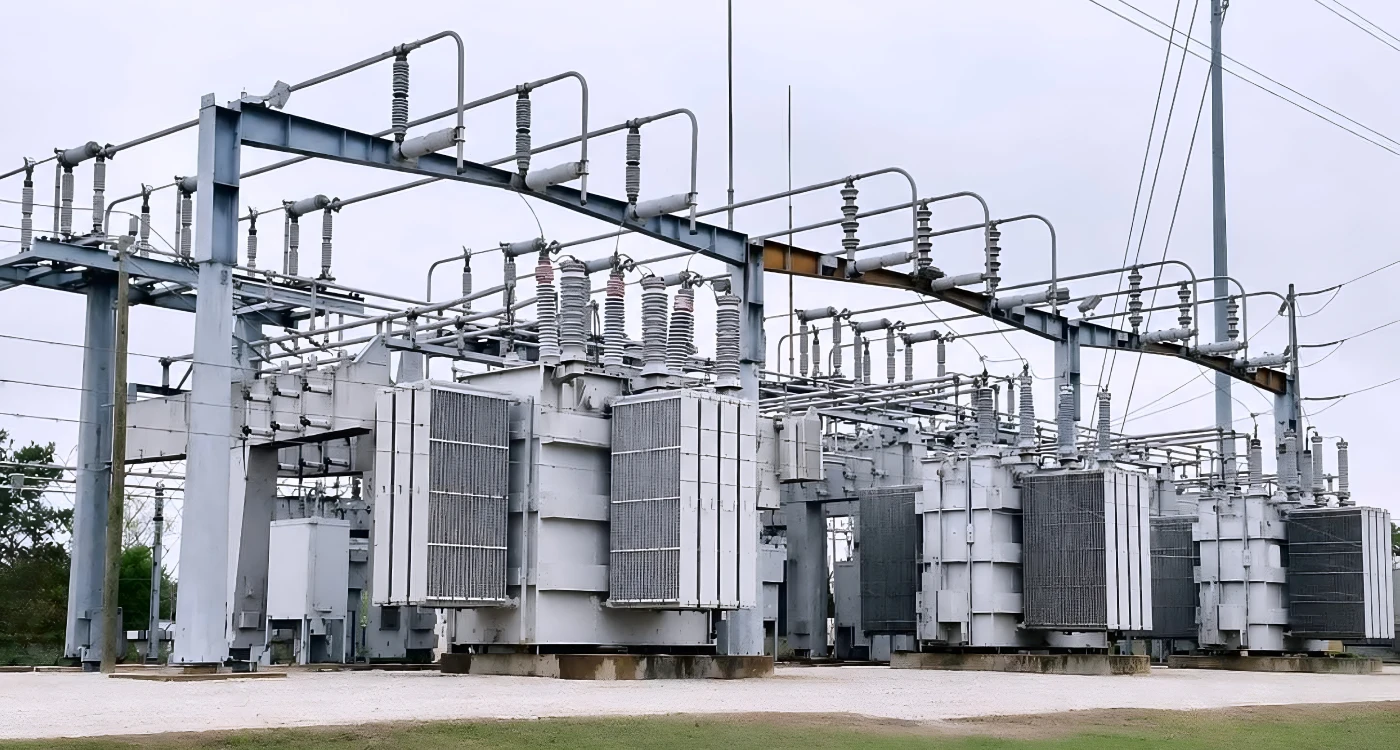
The guard helps most with outdoor bushing transformers (rain, dust, salt), industrial motors (oil, carbon), humid generators, and long outdoor cables, where readings without it won't reflect true condition.
The Guard as a Diagnostic, Not Just an Error Corrector
Comparing guarded and unguarded readings shows how much surface leakage contributes, since the two paths are parallel:
I (surface) = V × [1/R(unguarded) − 1/R(guarded)]
Take the unguarded reading, then the guarded one; neither alone shows if the problem is at the surface (cleanable) or bulk (not). For example: at 10 GΩ true resistance with the Row 4 salt-film condition, tested at 5 kV, a guarded 10 GΩ against an unguarded 0.91 GΩ gives a total current of 5.5 µA, with 5.0 µA (about 91%) from the surface. Logging this trend gives the cleaning crew an independent maintenance indicator.
Guard Band Positioning and Safety
- Use bare conductor or metal foil, wrapped closely against the insulation surface for full contact, placed between the voltage-carrying and earthed parts, as close to the earthed end as creepage distance allows.
- Route the guard leads away from the line lead and the surface under measurement; a lead resting on a moist bushing creates the path it's meant to prevent.
- Treat the guard lead as part of the live test path; don't touch it during testing.
- Place the band before applying test voltage, never during; remove only after discharge and confirmed zero volts.
- Never substitute the guard terminal for protective earth; on large capacitive systems, discharge both surface and bulk charge before touching the band.
- Follow standard safety procedures: isolation, lockout, dead-proving, discharge, earthing, removal of surge protectors, capacitors, VTs, CTs, and electronics, plus barricading the remote end.
When Not to Use the Guard
Skip guarding for clean, dry indoor equipment with no surface leakage; acceptance tests requiring unguarded readings; an existing unguarded trend (unless both are logged in parallel long enough to re-baseline); and cleaning-effectiveness checks, where before/after unguarded readings matter most.
The guard removes external leakage from the reading but doesn't fix contamination or repair the surface. In Row 5, guarding confirms bulk insulation stays at 10 GΩ even as carbon tracking cuts the unguarded value by 99%, though tracking remains a progressive fault that can raise flashover risk.
Using the guard doesn't improve insulation resistance; it reveals the true value by removing surface leakage. It isn't needed for every test either: cleaning and drying is usually enough for standard testing, with Guard reserved for likely surface leakage, per manufacturer guidance.
Role of Advanced Insulation Testers
Motwane's 5KPI and 10KPI Insulation Resistance Testers include a Guard terminal, built for transformers, motors, generators, switchgear, bushings, and power cables alongside other diagnostic tests for a fuller view of insulation condition. A digital display, adjustable test voltage, and controlled timing for PI and DAR calculations minimize errors, useful when testing multiple assets on-site quickly. For power generation or metallurgy, a tester that handles contamination without needing a spotless surface saves time while keeping results reliable.
Conclusion
Accurate IR measurement depends on confirming the recorded current reflects insulation's true condition, not surface contamination. The Guard terminal makes this possible by diverting surface leakage away from the measurement circuit. Used correctly, it also becomes a diagnostic tool, not just an error corrector. Motwane's 5KPI and 10KPI, with Guard terminal and diagnostics, help maintenance teams get accurate readings and make informed decisions about critical equipment.
 Aug 27, 2026